

Tax Office Certificate of Clearance When Buying Real Estate

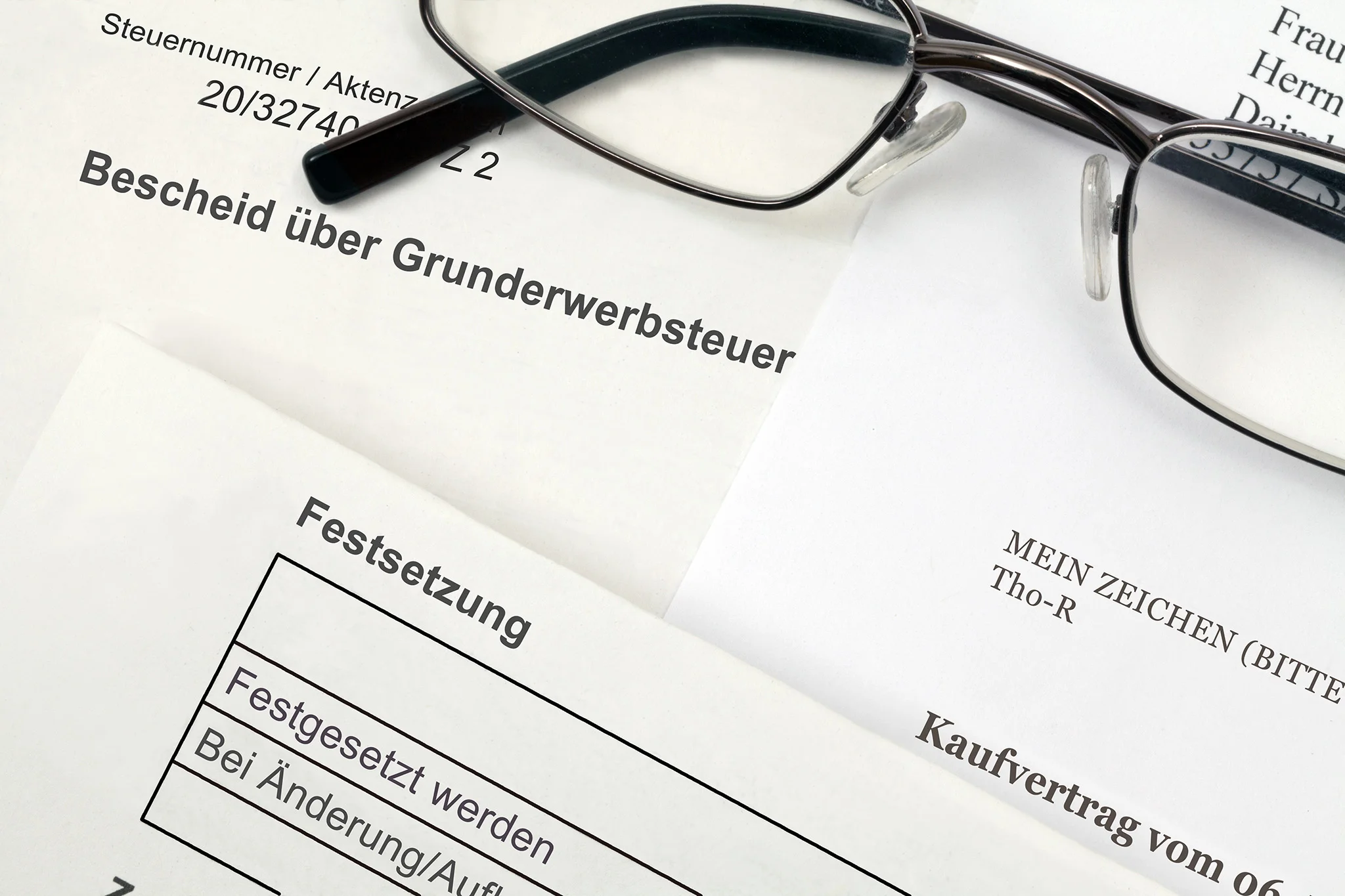
A certificate of clearance (Unbedenklichkeitsbescheinigung) is an official document by which an authority or institution confirms that, from its perspective, there are no objections to a particular transaction.
In the case of real estate, this refers to the tax clearance certificate issued by the tax office. It plays a central role when buying a house or property and is closely tied to the payment of the real estate transfer tax (Grunderwerbsteuer).
Without a real estate transfer tax clearance certificate, the change of ownership is generally not entered in the land register – and the buyer is therefore not yet the legal owner.
Other areas in which a certificate of clearance may be required
The term comes up in many areas of life, not just when buying real estate:
- Health insurance & social security: Insurers such as AOK, Barmer, DAK, Knappschaft, BKK or IKK issue certificates, for example confirming exemption from contributions or the absence of contribution arrears.
- Vehicle sector: When increasing the permitted load capacity of vehicles (e.g. caravans or motorhomes such as the Fiat Ducato, Citroën Jumper, Ford Transit) or when registering tyres, the manufacturer (e.g. Alko, Knaus, Bürstner, Fendt) confirms the technical safety for the TÜV inspection and registration.
- Employer’s liability insurance association (BG): In the construction and commercial sectors, clients often require a certificate of clearance from the relevant employer’s liability insurance association (e.g. BG ETEM or BG BAU) as proof that contributions have been paid.
- Authorities & other: The police (proof similar to a certificate of good conduct), customs authorities, universities/colleges (for studies) or doctors also issue corresponding certificates depending on the occasion.
All these variants share the same basic principle but differ in purpose, issuing body and procedure.
The tax clearance certificate when buying real estate
Anyone who acquires a plot of land, a house or a condominium must pay real estate transfer tax. The real estate transfer tax clearance certificate is the tax office’s proof that this tax obligation has been met or that nothing stands in its way.
Legal background
The legal basis is found in Section 22 of the Real Estate Transfer Tax Act (GrEStG). It stipulates that the buyer may only be entered as the new owner in the land register once the tax office’s clearance certificate is available. The land registry office is bound by this so-called entry block.
Section 22 GrEStG, in essence: The buyer should only be entered in the land register once the tax office has issued the clearance certificate – that is, once the real estate transfer tax has been paid, secured or deferred.
Why is it so important?
As long as the buyer is not listed in the land register, the transfer of ownership is not legally completed:
- The entry in the land register – and thus the secured acquisition of ownership – is blocked without the certificate.
- The financing bank also generally requires the secured land register entry before it regards collateral (e.g. the land charge) as fully valid.
- Delays can jeopardise follow-up appointments, the start of tenancies or resale plans.
The process: Who applies for what and when?
The good news for buyers: in the vast majority of cases, you do not have to do anything actively yourself:
- Notarised purchase contract: The notary notarises the property purchase and reports the transaction to the responsible tax office.
- Real estate transfer tax assessment: The tax office assesses the real estate transfer tax and sends the tax assessment notice to the buyer.
- Payment of the tax: The buyer pays the assessed real estate transfer tax within the specified deadline (usually about one month after notification).
- Issuance of the certificate: Once payment has been received, the tax office issues the clearance certificate.
- Transmission to the land registry office: The certificate is sent – often directly or via the notary – to the land registry office, which then makes the entry.
Do you have to request the certificate yourself?
Generally no. The notary manages the process. Increasingly, transmission even takes place electronically directly between the tax office and the land registry office, so that the buyer never physically receives the certificate at all. Anyone who needs their own copy (e.g. as a private individual for their own records) can request it from the tax office.
Requirements for issuance
The tax office issues the certificate as soon as the tax side has been settled. Specifically, it comes about in the following situations:
| Situation | Is the certificate issued? |
|---|---|
| Real estate transfer tax paid in full | Yes, usually promptly |
| Tax deferred or security provided | Yes, provided payment is secured |
| Transaction exempt from real estate transfer tax (e.g. certain acquisitions between relatives) | Yes, without payment |
| Tax still outstanding / not paid | No, issuance is withheld |
For certain tax-exempt acquisitions – for example within the family or in the context of an inheritance – no real estate transfer tax may be due. Even then, the clearance certificate is issued, because the tax claim does not stand in the way.
Duration: How long does issuance take?
There is no blanket answer, but there are empirical values:
- After payment is received: The tax office often issues the certificate within a few days to about two weeks.
- Overall process from notarisation: From the notarisation through the tax assessment to the finished certificate, several weeks usually pass, depending on the workload of the tax office.
What influences the duration
- How quickly the tax assessment is prepared and sent.
- How promptly the buyer pays the real estate transfer tax.
- The regional workload of the tax office (in large cities such as Berlin, Hamburg, Munich or Cologne, it may take longer).
Tip for property buyers: The most important lever you have in your own hands is paying the real estate transfer tax on time. Anyone who pays immediately after receiving the assessment notice noticeably speeds up the entire process.
Cost of the certificate of clearance
Issuing the real estate transfer tax clearance certificate itself is free of charge. The tax office does not levy a separate fee for it.
What actually “costs” the property buyer is the real estate transfer tax – the actual condition for the certificate. Its amount depends on the federal state:
| Example tax rates (depending on the federal state) | Real estate transfer tax rate |
|---|---|
| Bavaria | 3.5 % |
| Hamburg | 5.5 % |
| Berlin | 6.0 % |
| North Rhine-Westphalia | 6.5 % |
Note: The rates can change – check the current value for the relevant federal state before purchasing. The reference figure is generally the purchase price agreed in the contract.
Frequently asked questions (FAQ)
Where do I get the certificate of clearance?
From the tax office responsible for the property. The application or transmission is usually organised by the notary; you can request your own copy from the tax office.
Is there a form or template?
A classic application form for buyers is usually not necessary, because the process runs automatically through the notary and tax office. If an application is nevertheless desired, an informal letter with the reference number of the tax assessment is often sufficient. Some tax offices offer templates or an electronic process (in some cases via ELSTER).
Will I receive the certificate as a PDF?
As part of increasing digitalisation, many tax offices transmit documents electronically. Whether you specifically receive a PDF depends on the respective tax office and the chosen means of communication. When in doubt, ask the case officer.
Do tenants or landlords need such a certificate?
For a mere tenancy, the real estate transfer tax clearance certificate is not relevant – it concerns the acquisition of ownership, not the rental. Landlords as investors only come into contact with it when purchasing the property, not during the ongoing tenancy with their tenants.
What happens in the case of an inheritance?
When real estate is transferred in the context of an inheritance, separate tax rules apply. Often no real estate transfer tax is due here; depending on the situation, an inheritance tax certificate may become relevant. In such cases, seek individual advice.
Conclusion for investors
The tax clearance certificate is the decisive key to the land register entry, and thus to secured ownership, when buying real estate. Anyone who knows the process can actively speed it up:
- Keep a close eye on the tax assessment notice.
- Pay the real estate transfer tax immediately upon receipt.
- In the event of delays, follow up promptly with the notary or tax office.
This ensures that you are quickly listed as the rightful owner in the land register.
Further sources
- Section 22 Real Estate Transfer Tax Act (GrEStG) – Gesetze im Internet
- Real Estate Transfer Tax Act (full text) – Gesetze im Internet
- Federal Ministry of Finance
This article is for general information purposes and does not replace individual tax or legal advice