

The Property Handover Protocol

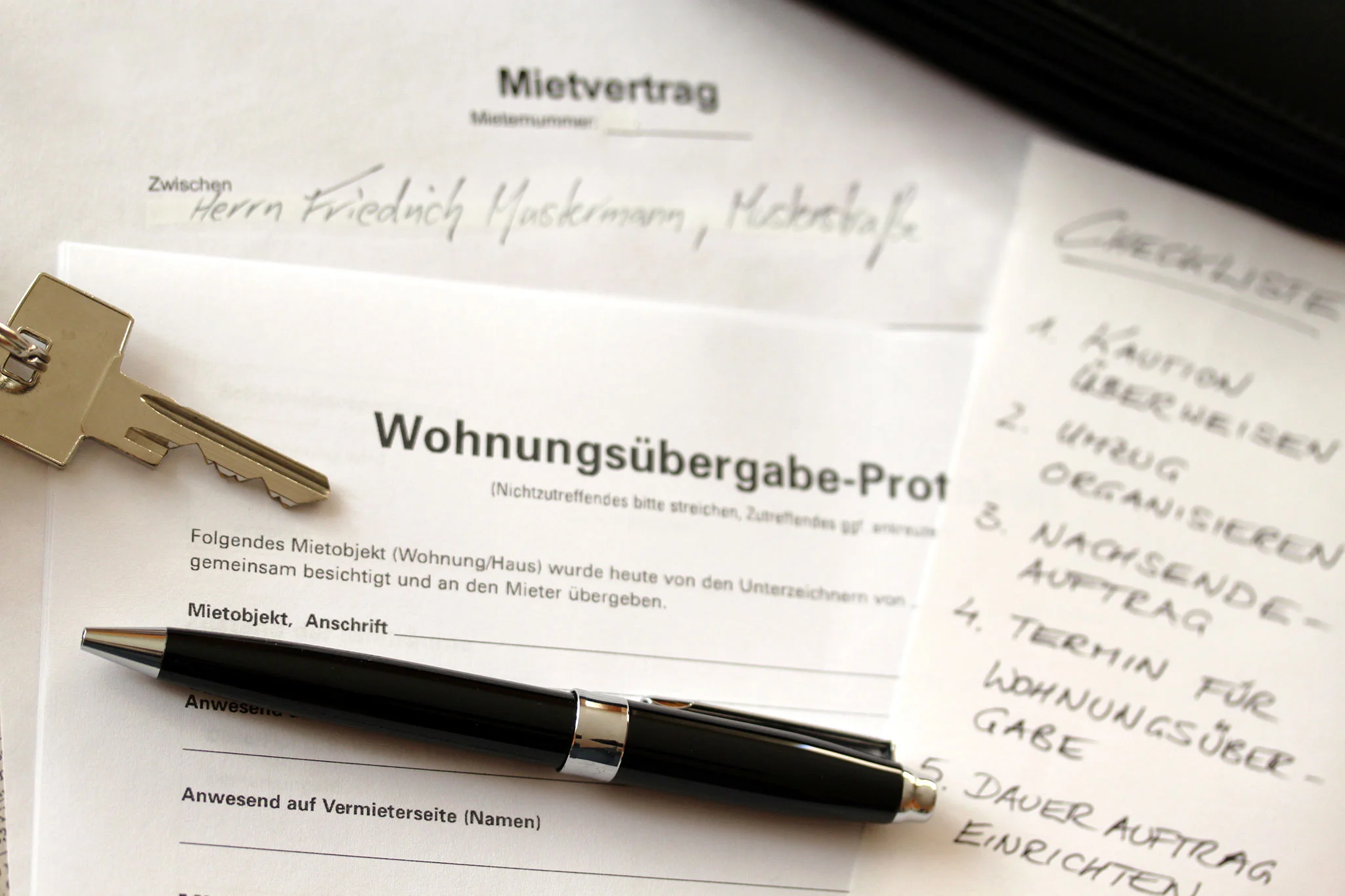
The handover protocol is the cheapest legal protection available at any property handover: one sheet of paper, two signatures, a few photos. It clarifies the burden of proof, secures the deposit, cleanly separates consumption periods and documents the handover of keys.
The Handover Protocol at the Property Handover: Why This Document Matters So Much
Whether moving in or moving out, renting or buying: the property handover is the moment at which the condition of a home changes hands – and with it the responsibility. A handover protocol (also called a property handover report, inspection report or takeover protocol) records this condition in writing. It documents defects, meter readings and the number of keys handed over, protecting both parties from later disputes.
This article explains what a handover protocol is, what evidentiary weight it carries, what belongs in it and what you should pay attention to at the property handover – when moving in as well as when moving out. You will also learn what applies if no handover protocol was drawn up, when a handover protocol can be invalid and which special rules apply to house sales, apartment purchases, furnished flats, rooms in shared flats or commercial premises.
What Is a Handover Protocol?
A handover protocol is a written document recording the condition of an apartment, a house or another object at the time of handover. It is drawn up, reviewed and signed jointly by both parties – in the case of a rented flat, by tenant and landlord. Typical contents are:
- condition of all rooms including floors, walls, ceilings, windows and doors
- existing defects and damage (list of defects)
- meter readings for electricity, gas, water and, where applicable, heating
- number and type of keys handed over
- condition of fixtures, fitted kitchen or furniture (in furnished flats)
- agreements, for example on remedying identified defects within a deadline
Important to know: a handover protocol is not required by law. Neither the German Civil Code (BGB) nor tenancy law obliges tenants or landlords to draw up a protocol at the property handover. In practice it is nevertheless strongly recommended – because without a protocol, later disputes often come down to one person’s word against another’s.
Distinction: Handover Protocol, Inspection Report, Takeover Protocol
The terms are largely used interchangeably. “Inspection report” (Abnahmeprotokoll) emphasises the landlord’s perspective of inspecting the flat at move-out, “takeover protocol” (Übernahmeprotokoll) that of the tenant taking it over at move-in. Legally, the label makes no difference. The document should not be confused with the construction acceptance report (Bauabnahmeprotokoll), which is drawn up towards the building contractor when a new building is accepted.
Legal Basis and Evidentiary Weight
Even though the handover protocol itself is not regulated by statute, the obligations surrounding the property handover follow from the tenancy law of the German Civil Code (BGB):
- Under Section 535 BGB, the landlord must hand over and maintain the flat in a condition suitable for the contractually agreed use.
- Under Section 538 BGB, the tenant is not responsible for wear and tear resulting from contractually compliant use – normal traces of everyday living are therefore not at the tenant’s expense.
- Under Section 546 BGB, the tenant is obliged to return the rented property at the end of the tenancy.
- Under Section 548 BGB, the landlord’s claims for compensation due to alterations or deterioration of the rented property become time-barred just six months after the flat is returned.
The short limitation period of Section 548 BGB makes clear why clean documentation at the handover is so important: the landlord must assert damage claims promptly, and the protocol provides the decisive evidence – for or against them.
What Evidentiary Weight Does the Handover Protocol Have?
A handover protocol signed by both parties is regarded in court as strong evidence. It documents the condition of the flat at the time of handover and generally creates a so-called negative evidentiary effect: defects not listed in the protocol are, as a rule, deemed not to have existed at the handover. Conversely, at move-out the tenant can rely on defects that were already recorded in the move-in protocol – the tenant is not liable for this damage.
Rule of thumb: what is not in the protocol effectively does not exist in a dispute. Therefore take enough time at the property handover – 30 to 60 minutes is realistic for a normal flat – and inspect every room in daylight.
When Is a Handover Protocol Invalid?
The question of when a handover protocol is invalid comes up again and again. The most important cases:
- Missing signature: A protocol drawn up unilaterally and signed only by the landlord does not bind the tenant. At best it has the value of a party’s own assertion.
- Deception or duress: If a party was pressured into signing or deceived about the contents, they can contest their declaration.
- Subsequent alterations: Entries added after signing without the other party’s consent are irrelevant. That is why both parties should receive an identical copy.
- Hidden defects: The protocol only covers visible defects. Concealed damage – such as water damage behind panelling – can still be asserted by the landlord later, provided the landlord proves that the tenant caused it.
- Vague wording: Blanket statements such as “flat in proper condition” without a room-by-room inspection carry little weight and can be discounted in individual cases.
Moreover, a signed protocol only operates as an acknowledgement of liability if this was recognisably intended. A tenant who confirms a defect in the move-out protocol does not automatically admit to having caused it. When in doubt, a handwritten note such as “defect recorded, cause disputed” helps.
Handover Protocol at Move-In and Move-Out: Two Situations, One Document
Ideally, a property handover protocol is drawn up twice in the life of a tenancy: at move-in and at move-out. The two protocols interlock – the move-in protocol is the reference against which everything is measured at move-out.
Handover Protocol at Move-In
At move-in, the interest lies primarily with the tenant: they document existing defects so that these are not attributed to them at move-out. Scratches in the parquet, a crack in a tile, a stiff balcony door – everything already present belongs in the move-in handover protocol. In addition, the protocol secures the meter readings at the start of the tenancy so that the first service charge statement and the electricity contract start off correctly.
Handover Protocol at Move-Out
At move-out, the interest reverses: now it is above all the landlord who documents the condition in which the flat is returned. For the tenant, the move-out handover protocol is just as important – it proves that the flat was returned properly and is a central basis for the repayment of the deposit. After the return, the six-month limitation period of Section 548 BGB for the landlord’s compensation claims also begins to run.
| Feature | Move-in handover protocol | Move-out handover protocol |
|---|---|---|
| Main interest | Tenant (protection against liability for pre-existing defects) | Landlord (documentation of new damage) and tenant (deposit repayment) |
| Reference point | Condition at the start of the tenancy | Comparison with the condition recorded in the move-in protocol |
| Meter readings | Opening readings for electricity, gas, water | Closing readings for the final bill and the service charge statement |
| Keys | Record the number of keys received | Document the complete return of all keys |
| Typical consequence of defects | Defect notification, remedy by the landlord where applicable | Deadline for the tenant to rectify or offsetting against the deposit |
| Legal effect | Evidence of pre-existing defects | Evidence of the return condition, start of the period under Section 548 BGB |
Tip: keep the move-in protocol for the entire duration of the tenancy – ideally also as a scan or photo in the cloud. In a tenancy lasting ten or more years, this document is often worth its weight in gold in a dispute over the deposit.
What Belongs in a Property Handover Protocol? The Complete Checklist
A good handover protocol for a flat follows a fixed structure. Whether you use a template as a PDF or a sample in Word – the following points should be included.
1. Details of the Property and the Parties
- full address of the flat including its location in the building (e.g. 2nd floor, left)
- names and addresses of tenant and landlord or buyer and seller
- date and time of the handover
- persons present, in particular witnesses
- type of handover: move-in, move-out, change of tenant or change of owner
2. Condition of the Rooms – Room by Room
Go through each room individually and note the condition of:
- floor coverings (parquet, laminate, tiles, carpet): scratches, stains, water damage
- walls and ceilings: paint condition, drill holes, cracks, traces of mould, nicotine deposits
- windows and doors: function, seals, broken glass, roller shutters
- electrical installation: switches, sockets, working lighting, doorbell, intercom
- sanitary facilities: fittings, seals, drains, silicone joints, toilet flush, instantaneous water heater
- radiators and thermostats: function and bleeding condition
- fitted kitchen (if let with the flat): test each appliance individually – hob, oven, fridge, dishwasher, extractor hood
- balcony, terrace, cellar, attic, garage and parking space, insofar as they belong to the flat
3. List of Defects with Deadlines
Each defect is described concretely: location, type, extent. Instead of “bathroom damaged”, write “washbasin in the bathroom: hairline crack approx. 5 cm on the right edge”. Dated photos complement the protocol ideally – note in the text that photos were taken and number them. Agree a concrete deadline for defects to be remedied and record who will carry out the remedy.
4. Meter Readings
Note all meter readings together with the meter number – more on this below in its own section.
5. Key Handover
Document the number and type of all keys – this too is covered in its own section below.
6. Other Agreements and Signatures
- agreements on decorative repairs or fixtures left behind (e.g. taking over the fitted kitchen for a payment)
- new address of the departing tenant for the deposit statement and the service charge statement
- place, date and signatures of both parties and, where applicable, of the witnesses
- note that both parties have received an identical copy
Meter Readings in the Handover Protocol: Electricity, Gas, Water and Heating
Documenting the meter readings is one of the most important parts of the handover protocol – and one of the most frequent points of dispute when it is missing. A handover protocol form with meter readings should provide the following details for each meter:
| Meter | Note the meter number? | Typical location | Important for |
|---|---|---|---|
| Electricity (peak/off-peak with dual tariff) | Yes, definitely | Hallway, cellar, meter cabinet in the stairwell | De-registration or registration with the electricity supplier, final bill |
| Gas | Yes | Kitchen, storage room, cellar | Gas supplier, heating cost statement for gas floor heating |
| Cold water | Yes | Bathroom, kitchen, cellar | Service charge statement |
| Hot water | Yes | Bathroom, kitchen | Heating and hot water cost statement |
| Heat cost allocators / heat meters | Yes, per radiator or per meter | On the radiators / in the distribution unit | Heating cost statement under the German Heating Costs Ordinance |
What Does a Handover Protocol for Electricity Look Like?
For reporting electricity, a simple table is essentially sufficient: meter number, meter reading, reading date, old and new contracting party. Many energy suppliers (such as E.ON, municipal utilities or the local default supplier) provide their own forms or online portals into which you transfer the values from the handover protocol. A separate “electricity handover protocol” is therefore usually not necessary – what matters is that the values are properly recorded in the property handover protocol and confirmed by both parties. Report the meter reading to the supplier promptly when the tenant changes; otherwise the supplier will estimate the consumption – often to your disadvantage.
Meter Readings at a Change of Owner
The same principle applies to a house sale or apartment sale: the meter readings on the handover date separate the consumption periods of seller and buyer. In addition, the oil level (for oil heating, including the remaining quantity in litres and the agreed price for the takeover) and the fill levels of LPG tanks or pellet stores should be recorded.
Worked Example: Why the Meter Reading Is Worth Real Money
Suppose you move out on 31 March but fail to document the electricity meter reading. The next tenant only moves in on 1 June, and the supplier estimates your consumption up to the next reading:
- Actual meter reading on 31 March: 34,180 kWh (not documented)
- Supplier’s estimate based on the previous year’s consumption up to 1 June: 34,630 kWh
- Difference: 450 kWh × €0.35/kWh = €157.50 overcharged
With a handover protocol signed by both parties, including the meter reading and a photo, the cut-off would have been unambiguous. The two minutes spent taking the reading pay off immediately.
Handover Protocol for Keys: Every Lock Counts
The key handover is the symbolic and legal core of the property handover: by returning all keys, the tenant gives possession of the flat back. A handover protocol for keys must therefore be complete. Record the type and number for every lock:
| Type of key | Number at move-in | Number at move-out | Remarks |
|---|---|---|---|
| Front door of the building | 2 | 2 | Part of a master key system |
| Apartment door | 3 | 3 | of which 1 duplicated key, agreed with the landlord |
| Letterbox | 2 | 2 | – |
| Cellar / garage | 1 | 1 | – |
Keys duplicated by the tenant must also be returned or verifiably destroyed at move-out. If the tenant keeps keys back, the flat may be deemed not to have been returned – with the consequence that the landlord can demand compensation for continued use.
Worked Example: A Lost Key in a Master Key System
If a key belonging to a central master key system is lost, the replacement can be expensive – but only if there is a risk of misuse and the system is actually replaced:
- Replacement of the apartment door cylinder: €120
- Proportionate replacement of the building’s central locking system (8 units): €1,600, of which a share can be passed on to the tenant depending on fault
- New keys (3 at €25 each): €75
Without a handover protocol, it is later almost impossible to clarify how many keys were handed out in the first place. A carefully maintained key register in the protocol protects both sides here.
No Handover Protocol – Who Bears the Burden of Proof?
What happens if no handover protocol was drawn up at move-in or move-out? This situation is more common than you might think – and it shifts the risk considerably.
No Handover Protocol at Move-Out: The Burden of Proof Lies with the Landlord
If the landlord demands compensation after the move-out, they must prove that the damage arose during the tenancy and is attributable to the tenant. Without a move-out handover protocol, the landlord often lacks the decisive evidence. Witnesses (such as the next tenant or a tradesperson) and dated photos can partially replace the protocol, but they are weaker. For tenants, however, this is no carte blanche: the tenant is also worse off without a protocol if the landlord alleges defects that did not exist at the return – or when it comes to the prompt repayment of the deposit.
No Handover Protocol at Move-In
If the protocol is missing at move-in, the tenant will later find it hard to prove that a defect already existed at the start of the tenancy. The courts do in principle assume that the landlord handed over the flat in a contractually compliant condition and that damage occurring during the tenancy must be explained by the tenant – but without documentation, the details quickly become murky. Anyone who moved in without a protocol should document the condition unilaterally after the fact: take photos with timestamps, notify the landlord of defects in writing without delay (defect notification by email or letter) and keep the notification.
The Landlord Refuses the Handover Protocol
There is no legal entitlement to a joint handover protocol – if the landlord refuses to cooperate, you cannot force them. Here is how to protect yourself anyway:
- Bring a neutral witness to the handover (not your spouse; better neighbours, friends or colleagues).
- Draw up your own protocol, have the witness sign it and verifiably offer the landlord the opportunity to countersign.
- Photograph or film every room systematically, including meter readings and the bunch of keys.
- Hand over the keys only against a receipt – if necessary by drop-off with a witness and written notice.
The same applies in mirror image for landlords if the tenant does not appear at the handover: document the condition with witnesses and inform the tenant of the result in writing.
Handover Protocol and Deposit: When You Get Your Money Back
The rental deposit (governed by Section 551 BGB, at most three months’ net cold rent) is closely tied to the handover protocol: a protocol without recorded defects is the tenant’s strongest argument for full repayment.
Landlord Withholds the Deposit Despite the Handover Protocol?
If the move-out protocol shows no defects, the landlord can only withhold the deposit within narrow limits – above all for outstanding or expected additional demands from the operating cost statement. For alleged damage that does not appear in the joint protocol, the path is largely blocked: the protocol produces the negative evidentiary effect described above. A review and settlement period of around three to six months after move-out is customary; for the final service charge statement, a reasonable partial amount may be retained for longer.
Worked Example: Deposit Settlement After Move-Out
- Deposit paid: 3 × €800 net cold rent = €2,400 plus €38 interest = €2,438
- Damage documented in the handover protocol (cracked washbasin, acknowledged by the tenant): − €180
- Retention for the outstanding operating cost statement (reasonably estimated): − €300
- Payout after the handover: €1,958, remainder after presentation of the statement
Wear and Tear or Damage? The Difference in Euros
Normal wear and tear is at the landlord’s expense (Section 538 BGB), genuine damage at the expense of whoever caused it. When assessing items in the handover protocol, the distinction with a deduction for current value helps: only the current value must be replaced, not the value as new. Example: carpet with a typical service life of ten years:
- Price as new incl. fitting: €1,500
- Age at move-out: 7 years → remaining service life 3 years
- Current value: €1,500 × 3/10 = €450 – the landlord cannot demand more for the irreparable burn mark caused by the tenant.
| Finding in the protocol | Normal wear and tear (landlord’s responsibility) | Damage (subject to compensation) |
|---|---|---|
| Walls | Yellowed paint, a moderate number of usual drill holes | Large-scale damage to the plaster, extreme colour choices without restoration where agreed |
| Parquet | Traces of foot traffic, light scratches | Deep gouges, water damage from plant pots, burn marks |
| Sanitary facilities | Limescale on fittings, dull surfaces | Cracked washbasin, enamel chipped by impact |
| Windows | Seals porous due to age | Broken glass, damaged handles |
Handover Protocol for House Sales and Apartment Purchases
It is not only tenants and landlords who benefit from the protocol: a handover protocol is also customary and sensible for a house sale, house purchase or apartment purchase – especially in a private house sale without an estate agent. It documents the condition of the property on the handover date, i.e. the moment at which possession, benefits and burdens pass to the buyer.
What Belongs in a Simple Handover Protocol for a House Sale?
- property, parties, date and reference to the notarised purchase contract
- condition of the building at handover, in particular changes or damage occurring since the viewing
- all meter readings (electricity, gas, water, heat) including meter numbers for the change of owner
- remaining heating oil or tank fill level with the agreed takeover price
- complete key handover – for a house purchase often an extensive bunch including side entrances, garage, letterbox
- documents handed over: energy performance certificate, building plans, heating maintenance records, chimney sweep certificates, insurance documents
- agreed items remaining in the property (fitted kitchen, awning, garden tools)
“Sold as Seen” – What the Protocol Can and Cannot Do
Properties are usually sold with liability for material defects excluded (“sold as seen”). However, this exclusion does not apply to fraudulently concealed defects (Section 444 BGB). The handover protocol for a house taken over “sold as seen” therefore has two main functions: it records that the condition has not deteriorated between conclusion of the contract and handover, and it documents the complete fulfilment of the handover obligations (keys, documents, vacant possession). Claims for concealed defects, by contrast, are governed by the purchase contract and Section 434 BGB, not by the protocol.
Special Case: Condominium Apartment
When selling a condominium apartment, the handover protocol should additionally include: handover of the declaration of division, the most recent minutes of the owners’ meetings, the annual statements and the business plan, the level of the maintenance reserve, and notifying the property manager of the change of owner. If the condominium is handed over with a tenant in place, the tenancy agreement, the handover protocols with the tenant and the deposit statement are added. The Verbraucherzentrale (German consumer advice centre) offers independent information and advice on house purchases and condominiums.
Templates and Samples: Using a Handover Protocol as a Free PDF or Word File
You do not have to design a handover protocol yourself. Free templates and samples are widely available – as a PDF to print out and fill in by hand or as a Word file to adapt on the computer:
- Tenants’ associations and the German Tenants’ Association (Deutscher Mieterbund) provide samples that tend to reflect the tenant’s perspective.
- Property owners’ associations such as Haus und Grund offer templates tailored to landlords; some documents are reserved for members.
- Consumer advice centres and municipal housing offices publish neutral checklists for the property handover.
- Property portals (e.g. Immowelt or ImmoScout24) also offer free handover protocols as PDF and Word files.
How to Recognise a Good Template
| Criterion | Good template | Weak template |
|---|---|---|
| Room structure | Separate block per room with fields for floor, walls, windows, doors | Just one free-text field “condition of the flat” |
| Meter readings | Table with meter number, reading, reading date per meter | A single line “meter readings: ___” |
| Keys | List by type of key with quantity | Total number without breakdown |
| Defects | Fields for description, cause, deadline and responsibility | Checkbox “defects present yes/no” |
| Signatures | Both parties plus witnesses, note on copies issued | Only one signature line |
Whether you choose a PDF or Word template is a matter of taste: the PDF is more tamper-proof and practical for handwritten completion on site, while the Word template can be adapted to the specific flat in advance (room list, existing fixtures). What matters in both cases: fill it in on site, go through it together, produce two copies, and have both parties sign.
Handover Protocols Beyond Real Estate: Cars, Company Vehicles, Work Equipment
The term handover protocol is not limited to flats. The basic principle – document the condition, record meter or mileage readings, acknowledge receipt – works everywhere possessions change hands:
| Area of use | Typical contents |
|---|---|
| Car (private sale, rental car) | Mileage, fuel level, paint damage, tyres, accessories, vehicle documents, number of car keys |
| Company car | Additionally fuel card, charging cable, first-aid kit, interior/exterior condition, return date for leasing |
| Work equipment (laptop, phone, tools, workwear) | List of devices with serial numbers, accessories, condition, obligation to return upon leaving |
| Club offices (e.g. treasurer) | Documents handed over, cash balance, accounts and access credentials, inventory |
For a vehicle handover protocol in a private car sale, automobile clubs such as the ADAC, among others, offer free samples. The structure follows the same logic as the property handover protocol – except that the mileage takes the place of the meter readings.
The Property Handover Step by Step
- Arrange the appointment: Hand over during the day in daylight if possible, with the flat empty and cleaned. Allow 30 to 60 minutes.
- Prepare the documents: Handover protocol template (in duplicate), tenancy agreement, move-in protocol, pen, torch, camera or smartphone, folding rule.
- Bring witnesses: A neutral companion considerably increases the evidentiary weight.
- Inspect room by room: Work systematically from the apartment door through each room, noting and photographing defects immediately.
- Read the meters: Document all meter readings with the meter number and a photo.
- Count the keys: Acknowledge the complete key handover in the protocol.
- Finalise the protocol: Read it through together, clarify open points, agree deadlines for remedying defects, enter the tenant’s new address.
- Sign and distribute: Both parties and witnesses sign; each side receives an identical copy.
Frequently Asked Questions About the Handover Protocol
Is a Handover Protocol Mandatory?
No. Neither tenants nor landlords are legally obliged to draw up a handover protocol. However, it is by far the most important piece of evidence in disputes over the condition of the flat and is therefore strongly recommended for both sides.
Do I Have to Sign the Handover Protocol?
No. If you disagree with individual findings, do not sign, or add a clarifying note (e.g. “scratches in the parquet already present at move-in, see move-in protocol”). A coerced or unchecked signature can later be held against you.
Does the Handover Protocol Apply Even Without a Clause in the Tenancy Agreement?
Yes. The protocol is a standalone agreement on the condition as found. It applies regardless of whether the tenancy agreement mentions a handover protocol. Conversely, the tenancy agreement can regulate the handover in more detail, for example the condition on return (“broom clean”).
Can the Landlord Report Further Defects After the Handover?
For visible defects, this is hardly possible any more after a protocol signed by both parties. Hidden defects, on the other hand, can still be asserted later – but only within the six-month limitation period under Section 548 BGB and only if the landlord can prove that the tenant caused them.
Is There a Handover Protocol in English?
For international tenants, a bilingual protocol (German/English, in English “handover protocol” or “move-in/move-out inspection report”) can be useful. The German version should be legally authoritative – this can be expressly stated in the document.
How Long Should I Keep the Handover Protocol?
At least until the final deposit settlement after the move-out, better still until the limitation periods have expired – as a rule of thumb, three years after the end of the tenancy. Keep the move-in protocol for the entire duration of the tenancy.