

Calculating Living Space – What Counts, What Doesn’t?

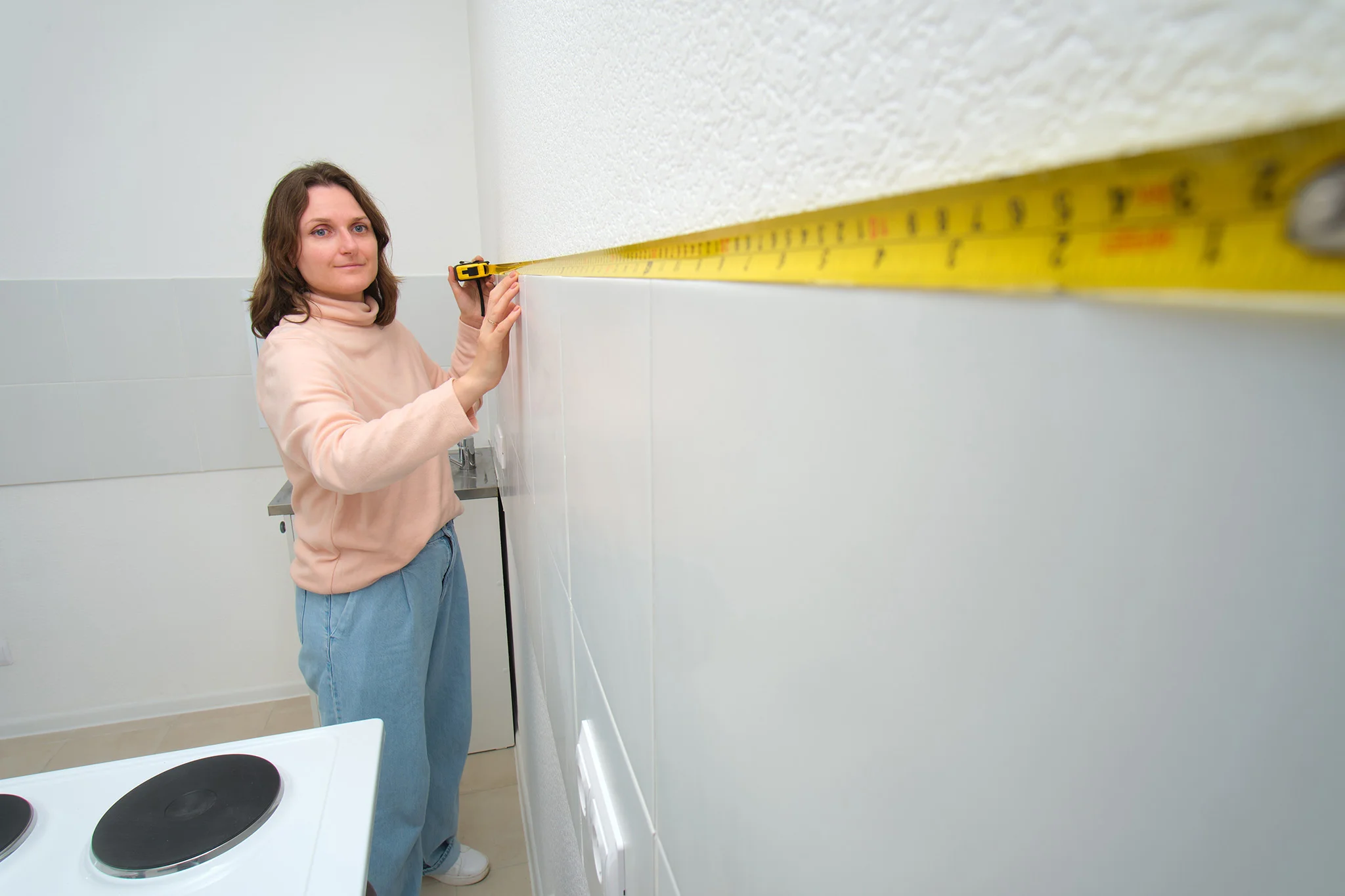
Living space is the sum of all floor areas of rooms that belong exclusively to a dwelling, minus certain deductions (e.g. sloped ceilings, wall areas) and taking into account reduction factors for balconies, terraces or conservatories.
Why is it so important to calculate living space correctly?
The stated living space has real financial consequences – for tenants, landlords, buyers and owners alike:
- Rent: The living space is the basis for the cold rent per square metre as well as for utility bill statements.
- Buying and selling: The living space largely determines the purchase price of a property.
- Building and contents insurance: Insurers often calculate premiums based on the insured living space.
- Property tax: As part of the property tax reform, the living or usable space is factored directly into the calculation in many federal states.
- Heating costs and CO2 emissions: The allocation key for heating costs and CO2 cost sharing is often based on the living space of the individual units.
- Bank financing: Banks use the living space to assess the loan-to-value limit for mortgage loans.
An incorrectly stated living space can have legal and financial consequences in the event of a dispute – for example, rent reductions due to area discrepancies. Courts generally do not accept deviations of more than 10% from the area stated in the lease.
Living Space Ordinance (WoFlV) vs. DIN 277: What actually applies?
In Germany, there are two different sets of rules according to which areas can be calculated – which often leads to confusion in practice.
The Living Space Ordinance (WoFlV)
The Living Space Ordinance (Wohnflächenverordnung, WoFlV) has been the authoritative basis for tenancies since 2004 and precisely defines which areas are counted and to what extent – see also the Living Space Ordinance.
DIN 277
DIN 277, on the other hand, is a technical standard for calculating floor areas and room volumes in construction (gross floor area, net room area, usable area). It is mainly used in the commercial sector and in building planning, but it is not the authoritative legal basis for calculating living space under tenancy law.
| Criterion | Living Space Ordinance (WoFlV) | DIN 277 |
|---|---|---|
| Main area of application | Tenancy law, residential properties | Building planning, commercial properties |
| Takes sloped ceilings into account | Yes, in tiers (0% / 50% / 100%) | No, not provided for in this form |
| Balcony/terrace allowance | Usually 25% (max. 50%) | Not provided for |
| Legal weight in a lease | Yes, established case law | Uncommon in residential leases |
The formula for calculating living space
The basic formula under the WoFlV is, in simplified form:
Living space = floor area of the rooms × reduction factor (minus wall, column and pillar areas as well as non-eligible ancillary rooms)
In concrete terms, this means:
- Determine the floor area of each room from the floor plan (length × width in metres).
- Deduct areas that do not count towards the living space (e.g. wall areas, door recesses, freestanding pillars and columns above a certain size).
- Apply reduction factors for special areas (sloped ceilings, balcony, terrace, conservatory – see table below).
- Add up all the partial areas.
Important: The basis is always the clear height of the room – i.e. the actual height between the floor and the ceiling or sloped ceiling, measured without flooring or cladding.
What counts as living space – and what doesn’t?
In principle, only rooms that are assigned exclusively to the respective dwelling count.
Rooms that count fully towards living space
- Living and bedrooms
- Kitchen
- Bathroom, toilet
- Children’s rooms
- Hallway within the dwelling
- Storage rooms within the dwelling
Rooms that do not count towards living space
- Basement rooms (even if converted, they usually count towards usable space, not living space)
- Attic (unheated, unconverted)
- Garage and parking spaces
- Boiler room, laundry room, utility room outside the dwelling
- Stairwell and communally used hallways
Reduction factors for special areas under the WoFlV
| Area / room | Allowance |
|---|---|
| Rooms with a clear height ≥ 2.00 m | 100% |
| Rooms/sloped areas with a clear height of 1.00–2.00 m | 50% |
| Rooms/sloped areas with a clear height below 1.00 m | 0% (not counted) |
| Balcony, terrace, loggia | usually 25%, up to 50% in exceptional cases |
| Unheated conservatory, swimming pool | 50% |
| Heated conservatory | 100% |
Calculating sloped ceilings correctly (attic storey)
Especially in an attic apartment or a converted attic, sloped ceilings are the most common point of contention in living space calculations. The rule under the WoFlV is clearly tiered according to the clear room height:
- From 2.00 m height: The area counts 100% towards the living space.
- Between 1.00 m and 2.00 m height: The area only counts by half (50%).
- Below 1.00 m height: This area is not counted at all, regardless of how it is used.
In practice, this means: you measure the floor plan of the attic storey and mark the lines at which the sloped ceiling reaches a height of 1.00 m and 2.00 m respectively. The area is then divided into the three zones and added up with the appropriate weighting.
Example calculation for a sloped ceiling
| Zone | Area | Allowance | Result |
|---|---|---|---|
| Height ≥ 2.00 m | 12 m² | 100% | 12.00 m² |
| Height 1.00–2.00 m | 8 m² | 50% | 4.00 m² |
| Height < 1.00 m | 5 m² | 0% | 0.00 m² |
| Total living space of the room | 16.00 m² | ||
Balcony, terrace and conservatory: how outdoor areas are counted
Balconies, terraces and loggias often belong functionally to the dwelling, but they are not counted in full towards the living space. Under the WoFlV, an allowance of 25% of the respective floor area usually applies.
In particularly high-quality or particularly generous cases, the allowance may be up to 50% in individual cases – however, this is an exception and depends on the quality and location of the area.
- Balcony: usually 25% of the floor area
- Terrace: usually 25% of the floor area
- Loggia: usually 25% of the floor area
- Conservatory (unheated): 50% of the floor area
- Conservatory (heated): 100% of the floor area
Since this allowance is often underestimated or calculated incorrectly, it is worth taking a close look at the figures used in the listing when buying or selling a property.
Living space, usable space and floor area – what’s the difference?
These three terms are often mixed up in everyday language, but they mean different things:
- Floor area: The total floor area of a building or room, regardless of use. A distinction is made, among other things, between gross floor area (GFA, total area including walls) and net floor area.
- Usable area: All areas that serve a particular purpose, but not necessarily residential purposes – for example cellars, hobby rooms, storage rooms or utility rooms.
- Living space: The area specifically calculated according to the WoFlV that serves residential purposes exclusively and is stated in leases or property listings.
An example: a converted but unheated basement room counts towards the usable area of the house, but not towards the living space of the dwelling.
Step-by-step guide: calculating living space yourself
Here’s how to proceed in practice when calculating living space:
- Get the floor plan: Use the existing building plan/floor plan or create a scaled sketch of all rooms yourself.
- Measure the rooms: Measure each room individually with a folding rule or laser distance meter (length × width), ideally at skirting board height.
- Check room heights: Check the clear height at several points, especially in attic rooms.
- Deduct non-eligible areas: Subtract wall areas, pillars, columns larger than 0.1 m² and areas below 1.00 m in height.
- Apply reduction factors: Weight sloped ceilings (50%), balcony/terrace (25%) and other special areas accordingly.
- Add up all partial areas: The sum of all weighted room areas gives the total living space.
- Document it: Record the calculation in writing (ideally as a template with floor plan, measurements and subtotals) so that it is traceable in the lease or property listing.
Calculating living space online: use free calculators
Anyone who wants to make the manual calculation easier can use free online living space calculators. These tools usually automatically take into account the WoFlV reduction factors for sloped ceilings, balconies and terraces.
Information and templates are provided, among others, by the German Tenants’ Association (Mieterbund) and the Consumer Advice Centre (Verbraucherzentrale). Stiftung Warentest, the German consumer organisation, has also covered living space calculation in detail on several occasions at test.de.
Check whether the calculation is based on the WoFlV or on DIN 277. For leases in Germany, the WoFlV is the relevant basis.
Common mistakes when calculating living space
- Stating floor area instead of living space: The pure floor area, without taking sloped ceilings and wall deductions into account, is usually too high.
- Counting a balcony or terrace at 100%: These areas may generally only be applied at 25%.
- Ignoring sloped ceilings: If the entire floor area of an attic room is applied without taking the height zones into account, the result is almost always too high.
- Including basement or garage areas: These belong to the usable area, not the living space.
- Using the wrong standard: Applying DIN 277 instead of the WoFlV often leads to different results for residential properties.
Frequently asked questions about calculating living space
From what point does a sloped ceiling count towards the living space?
Areas under a sloped ceiling count by half (50%) from a clear height of 1.00 m and fully (100%) from 2.00 m towards the living space. Below that (under 1.00 m), they are not counted at all.
Does a balcony count towards the living space?
Yes, but usually only at 25% of its floor area. Only in exceptional cases – for example with particularly high-quality fittings – can the allowance be up to 50%.
Does the basement count towards the living space?
No, basement rooms generally do not count towards the living space, but towards the usable area of a building – regardless of whether they have been converted.
What is the difference between gross and net area?
The gross area (or gross floor area) also includes walls, columns and pillars, whereas these structural elements are deducted for the net area or living space.
How can I calculate the living space for free?
With a folding rule or laser distance meter, the floor plan of the dwelling and the WoFlV formula, the living space can be calculated completely free of charge yourself. Alternatively, free online calculators help with the automatic calculation, including reduction factors.
Is the living space calculation the same in every federal state?
Yes, the WoFlV applies uniformly nationwide, i.e. equally, for example, in Bavaria as in North Rhine-Westphalia. However, differences can arise in state-specific regulations on property tax.