
Certificate of self-containment: component of the declaration of division

Anyone wishing to divide an apartment building into individual condominium units in order to sell, bequeath or gift them separately needs a certificate of self-containment (Abgeschlossenheitsbescheinigung).
Certificate of self-containment: what it is and why you need it
The certificate of self-containment confirms that the individual residential or commercial units within a building are structurally clearly separated from one another and therefore independently usable. In everyday language, the term “declaration of self-containment” (Abgeschlossenheitserklärung) is occasionally used as well – this refers to the very same document.
Without this certificate, the land registry cannot create separate condominium land registers (Wohnungsgrundbücher) for the individual units. It is therefore the formal prerequisite for establishing freehold apartment ownership and part-ownership (Wohnungs- und Teileigentum) under the German Condominium Act (Wohnungseigentumsgesetz, WEG).
You need the certificate of self-containment whenever you want to divide a building into separately saleable condominium units. If you only intend to rent out the apartments, it is not required.
Significance and legal basis
The certificate of self-containment is an official declaration of knowledge (behördliche Wissenserklärung) – expressly not an administrative act. This means: the building authority merely confirms an actual structural condition, but does not make any legally constitutive decision.
The legal basis is in particular Section 7 (4) and Section 3 (3) WEG, supplemented by the General Administrative Regulation for the Issuance of Certificates under the Condominium Act (Allgemeine Verwaltungsvorschrift für die Ausstellung von Bescheinigungen nach dem Wohnungseigentumsgesetz, AVA), which has been in force in its revised version since 12 July 2021.
The certificate checks only the spatial and functional self-containment – not building law. An illegal or unapproved structural condition is neither legalised nor tolerated by it. If you fail to comply with applicable building law, the certificate of self-containment does not protect you from sanctions by the building supervisory authority.
When you need the certificate
- when converting an apartment building into individual condominium units
- when separating off commercial units (part-ownership)
- when establishing special property (Sondereigentum) for parking spaces
- to assert a permanent residential right (Dauerwohnrecht) under Section 32 WEG
- often also as a document requested by banks in connection with property financing
You will find further information on the legal basis in the wording of Section 7 WEG as well as in the General Administrative Regulation (AVA).
In this video, Axel Fischer explains the certificate of self-containment once more in simple terms:
Requirements: when does a unit count as self-contained?
For a residential unit or a room not used for residential purposes to count as “self-contained”, certain structural criteria must be met. What matters is solely the actual, spatial and functional separation.
Minimum structural requirements
- Complete structural separation: the unit must be completely separated from other people’s apartments and rooms by walls and ceilings.
- Own lockable access: access must be directly from the outside, from a stairwell or from an anteroom. It must not lead through another unit of special property, and only with a registered easement across a neighbouring plot.
- Independent household management: a residential unit must allow an independent household to be run – this usually includes a kitchen or cooking facility, water supply, drain and a WC.
Incidentally, a unit does not lose its character as a residential unit if individual rooms are used temporarily or permanently for professional or commercial purposes. For parking spaces and parts of the plot lying outside the building, a clear definition by means of measurements is sufficient.
What generally does not count as self-contained
Open spaces such as terraces, balconies, loggias or roof terraces generally do not count as self-contained under building law, because they lack complete spatial enclosure. In practice they are often governed by a special right of use (Sondernutzungsrecht) rather than by special property.
The partition plan as the central document
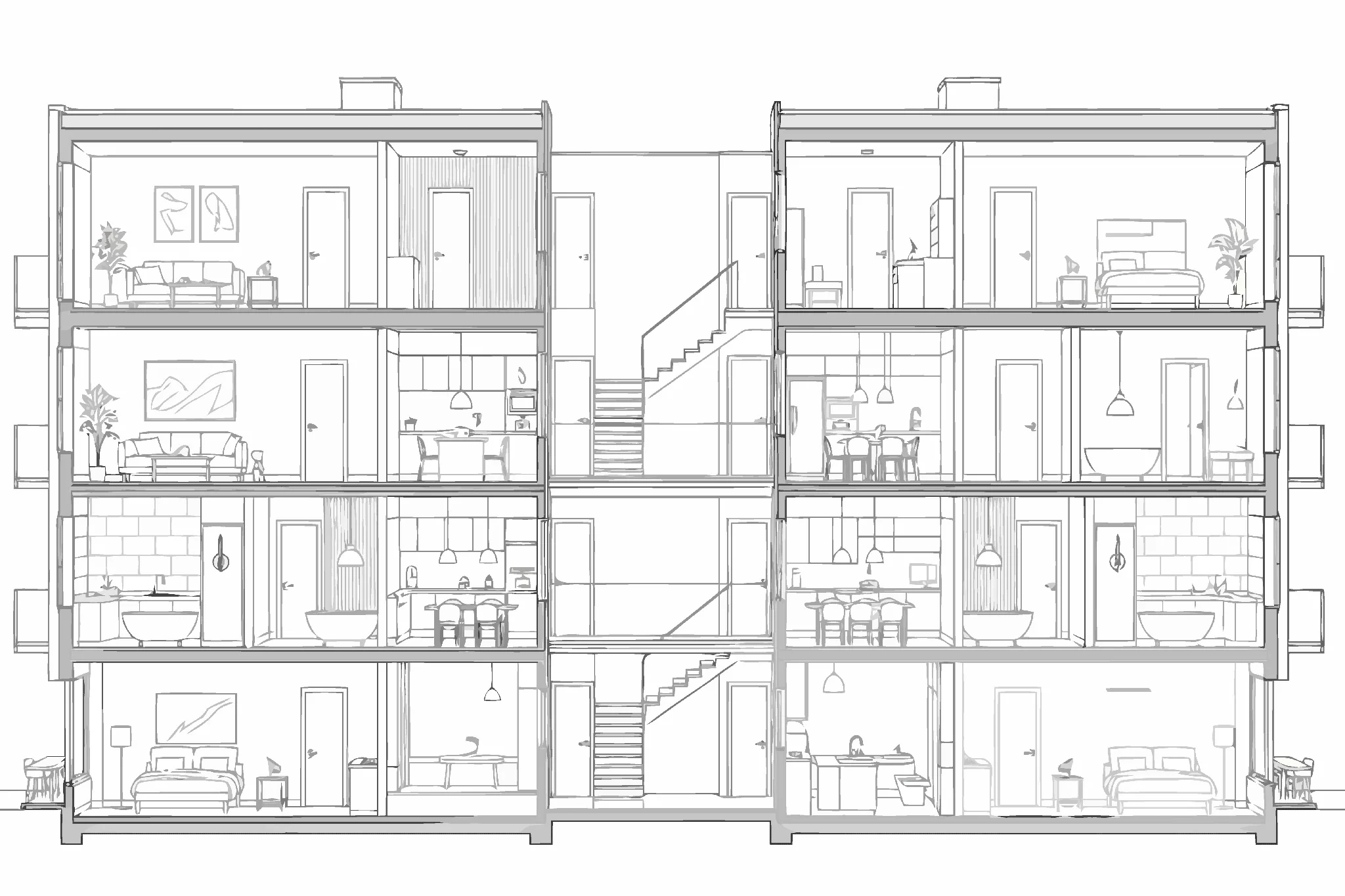
Inseparably linked to the certificate of self-containment is the partition plan (Aufteilungsplan). It is a scaled construction drawing that depicts all parts of the building and shows the boundaries between special property and common property (Sonder- und Gemeinschaftseigentum) clearly and unambiguously.
What the partition plan must contain
- floor plans of all storeys from the basement to the attic (usually at a scale of 1:100)
- sections and elevations relating to the entire building
- a clear, consistent numbering: all rooms belonging to the same unit bear the same number – common areas are often marked with a “G”
- living and usable floor area calculations
- the inclusion of all buildings on the plot, including garages, sheds and outbuildings
The partition plan is usually drawn up by an architect or structural engineer, since this requires authorisation to submit construction documents and technical precision. For new builds, the plan must match the approved construction plans; for existing buildings, it must reflect the actual condition as a building survey drawing (Baubestandszeichnung). In terms of format, the construction drawing must not exceed DIN A3 and must be submitted in duplicate when applying in writing.
Practical tip: Check in advance whether the existing plans correspond to the actually approved condition. Unapproved layout changes, merged apartments or converted attics frequently lead to delays or rejection – in such cases a building application may be required beforehand.
Application and procedure: how to apply for the certificate
In most cases, the responsible body is the lower building supervisory authority – colloquially “the building authority” (Bauamt) – at the location of the property. Since the WEG reform of 2007, the federal states may stipulate by statutory order that publicly appointed and recognised experts for construction may alternatively issue the certificate. Whether this is possible in your federal state is best clarified directly with your responsible authority.
Who is entitled to apply?
Entitled to apply are owners and holders of heritable building rights (Erbbauberechtigte), as well as any person who credibly demonstrates a legitimate interest (for example a purchaser). With appropriate power of attorney, an estate agent or architect may also submit the application on your behalf.
Required documents
Which documents exactly are required varies from authority to authority. As a rule, you will need:
- the completed application (often as an official form, otherwise an informal letter is sufficient) with the description of the plot, the owner’s name and address as well as the owner’s signature
- the partition plan in duplicate
- a current land register extract or purchase contract (often no older than one year)
- a site plan showing all buildings and structures
- living and usable floor area calculations
The procedure in five steps
- Preparation: an architect or expert draws up the partition plan and reviews the building law situation.
- Submission: you submit the application and documents to the responsible body.
- Review: the authority checks the self-containment according to the rules of the WEG.
- Issuance: if all requirements are met, you receive the certificate together with the sealed partition plan.
- Further use: the certificate and the declaration of division (Teilungserklärung) are submitted together to the land registry.
The processing time depends heavily on the respective authority and can range from around two weeks to three months. In metropolitan areas with overburdened authorities – such as Berlin – you should expect longer periods and plan a buffer accordingly.
Cost of the certificate of self-containment
The costs are not regulated uniformly throughout Germany, but are governed by the respective state or municipal fee schedule. In principle, they are made up of two parts: the official fees and the costs of preparing the plan.
Official fees
For the issuance alone, depending on the region and the size of the apartment, fees of usually between around 30 and 250 euros per unit apply. For very complex building divisions, it can also be more expensive. The following overview shows typical orders of magnitude – binding information is always provided by the local fee schedule:
| Region / city | Typical fee | Particularity |
|---|---|---|
| Munich (Bavaria) | approx. €25–150 | plus approx. €50 for the partition plan |
| Berlin | approx. €74 per unit | longer processing times possible |
| Hamburg | varies | distinction between new builds and existing stock |
| Hesse | up to approx. €325 | depending on apartment size |
| General (Germany) | approx. €50–250 per unit | varies by municipality |
A calculation example: for a Berlin apartment building with 15 units and a fee of 74 euros per unit, the official fees alone amount to around 1,110 euros.
Architect’s costs and total expenditure
The larger cost factor is usually the preparation of the partition plan by an architect. This is frequently billed according to the HOAI (the German fee structure for architects and engineers) or as a flat rate. A flat rate provides planning certainty, while billing according to the HOAI can be worthwhile for extensive surveys of existing buildings – it is best to obtain both types of quote. Including the architect’s fee, the total expenditure, depending on the property, is often in the range of around 500 to 1,800 euros, and for complex divisions with additional services even more.
Not to be forgotten: notary and land registry costs for the declaration of division are incurred separately and are governed by the Court and Notary Costs Act (Gerichts- und Notarkostengesetz) and the market value of the property. The certificate itself, however, does not come from the notary, but from the building authority.
Note on tax: If you acquire and rent out the property, the costs – such as the architect’s fee and official fees – may, under certain circumstances, be claimed for tax purposes as incidental acquisition costs via depreciation (AfA). Seek individual advice from a tax adviser on this.
Difference from the declaration of division
The certificate of self-containment and the declaration of division (Teilungserklärung) are often confused because they are closely related – but they are not the same thing. The key point: the certificate of self-containment is only one of several components of the declaration of division.
| Feature | Certificate of self-containment | Declaration of division |
|---|---|---|
| Issued by | building supervisory authority / expert | owner, notarised |
| Content | confirmation of structural self-containment | legal division into special and common property |
| Function | technical proof | legally constitutive declaration |
| Components | standalone document | includes, among other things, the partition plan, the certificate of self-containment and the community rules (Gemeinschaftsordnung) |
The procedure is therefore staged: first the architect draws up the partition plan, then the authority issues the certificate of self-containment. Subsequently, with the involvement of a notary, the declaration of division is drawn up and submitted to the land registry together with the certificate. Only once separate condominium land registers have been created is the division complete and the separate sale of the units possible.
Common pitfalls – and how to avoid them
In practice, divisions regularly fail because of details that only become apparent on closer inspection. With these points you increase the chance of a smooth issuance:
- Consistency with the land register: the cadastral district, parcel and plot (Gemarkung, Flur, Flurstück) and the owner data must match the land register exactly. Discrepancies frequently lead to chargeable supplementary requests.
- Consistent numbering: each unit must be numbered identically in the partition plan – and match exactly the later declaration of division.
- Approved condition: if the plans do not match the approved condition, clarify in advance with the building supervisory authority whether a building application is required.
- Complete documents: missing or incorrect documents are the most common cause of delays. Many building authorities offer consultation appointments.
For more complex projects, it is worth involving an architect or expert authorised to submit construction documents at an early stage, who can handle the partition plan, the floor area calculation and, if necessary, the legalisation of structural changes from a single source.