

German Buildings Energy Act GEG: “Heizungsgesetz” 2024


The Building Energy Act (GEG) – colloquially known as the Heating Law – regulates the gradual transition to climate-friendly heating systems. Following profound course corrections by the Union-led federal government under Chancellor Friedrich Merz, the law was fundamentally reformed with a focus on technological openness and economic viability: strict prohibitions for existing buildings were eased, and the priority has shifted to pragmatic solutions without state coercion.
What does the reformed Heating Law mean currently?
The strict requirements of the GEG focus primarily on new construction within designated new development areas. Anyone building here is legally required to install a heating system that relies on at least 65 percent renewable energy. In contrast, new builds in vacant plots outside of such development areas fall under the more flexible regulations for existing buildings.
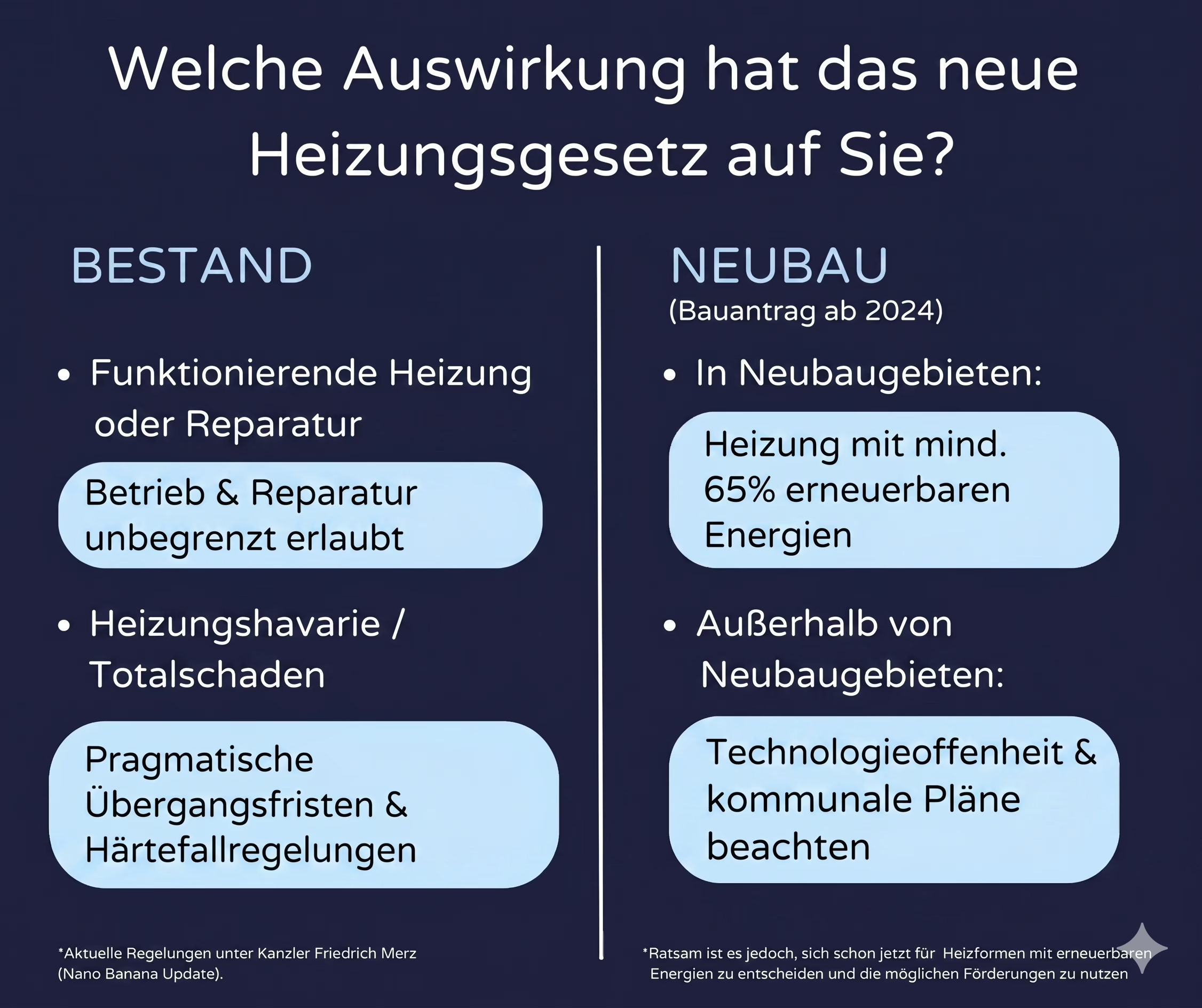
Source: Own representation
For existing property owners, there is a noticeable relief: there is no immediate replacement obligation for functioning heating systems. Existing gas or oil heating systems may continue to be operated indefinitely and can be repaired in the event of a defect. The rigid retrofitting obligations for existing stock passed by the previous government have been largely relaxed under the Merz administration.
Existing buildings and municipal heat planning
The obligations for existing structures and new builds outside of development areas are linked to municipal heat planning. Major cities (over 100,000 inhabitants) must submit their heat plans by mid-2026, while smaller municipalities have until 2028.
Important for owners: As long as there is no final and legally binding heat plan in your municipality, absolute technological openness and free choice of heating systems continue to apply. Even thereafter, current legislation relies heavily on incentives rather than regulatory bans.
The law from the perspective of property owners
Which heating system am I currently allowed to install?
Freedom of choice still prevails for existing stock and vacant plots. However, anyone choosing to install a modern gas or oil heating system today should keep long-term economic viability in mind.
Although the original, rigid mandatory shares for biomass or hydrogen from 2029 onward were made significantly more flexible by the Merz government to protect owners from utopian retrofitting costs, the foreseeable development of CO2 pricing will still lead to rising operating costs for fossil fuels. The final ban on the use of fossil heating systems in 2045 remains in place as a long-term climate goal.
What happens if the heating system breaks down beyond repair (heating emergency)?
If a heating system can no longer be repaired, practical and generous transitional periods apply. In the event of such an emergency, a classic gas or oil heating system may temporarily be used again (for example, via a second-hand or rented unit).
The deadline for the subsequent switch to a sustainable solution is at least 5 years. If a connection to a municipal heating network is foreseeable, this period is extended to 10 years; for gas floor heating systems, it is even up to 13 years. In addition, comprehensive hardship regulations safeguard owners if the investment costs are disproportionate to the property value.
Which heating technologies are future-proof?
To meet the required sustainability criteria – or to position real estate securely for the future – a broad and technologically open spectrum of options is available:
- Connection to a district or local heating network: The most convenient solution, especially in urban areas.
- Heat pumps (air or geothermal): The highly efficient standard for well-insulated buildings.
- Hybrid heating systems: The combination of a fossil fuel system (gas/oil) for peak loads and a heat pump or solar thermal system for the base load.
- Direct electric heating / Infrared heating: A cost-effective option for highly insulated properties with low heat demand.
- Solar thermal systems: Ideal as a supporting component for water heating and backup heating support.
- Biomass heating (pellet or wood heating): Re-established under the current government as a fully-fledged and sustainable option for existing stock.
- H2-Ready gas heating: Gas heating systems that can be converted to operate on 100% hydrogen (primarily relevant for existing buildings).
Which system is energetically and economically sensible requires a case-by-case evaluation. Independent guidance is offered by qualified energy consultants listed on the official directory of Energy Efficiency Experts. Consumer advice centers also offer state-subsidized initial consultations.
Impact on the real estate market
The energy balance as a decisive value factor
Energy status has long since become a primary criterion in property valuation. Objects that already meet modern energy standards achieve significant premiums and are in high demand on the market. For properties in need of renovation, prospective buyers must factor upcoming modernization costs into price negotiations from the very beginning.
Significance for landlords and tenants
Landlords who invest in a new, climate-friendly heating system can pass the modernization costs on to the rent. The modernization levy has been raised to a maximum of 10 percent of costs per year, provided that government subsidies were applied for and deducted from the total amount. Without utilizing subsidies, the limit stands at 8 percent.
To protect tenants from financial overload, the monthly modernization levy for a pure heating exchange is strictly capped at 50 cents per square meter. Broader measures, such as facade insulation or window replacement, fall under the regular modernization levy (up to 3 euros per square meter). Statutory hardship regulations protect low-income tenants from unreasonable rent increases.
Meine-Renditeimmobilie consistently relies on future-proof and energetically optimized properties with excellent energy performance certificates for its own project development. The specifications of the Building Energy Act are integrated into our planning as standard right from the start.
Our properties are technically and economically designed to meet statutory criteria in the long term, serving as value-stable, high-yield capital investments. Should future energy adjustments become necessary for a project, we calculate these costs transparently into the investment right from the beginning.
Current subsidy landscape: State support for the transition
The switch to renewable energies is supported by attractive state grants and low-interest loans from the KfW. The subsidy structure was simplified under the Merz administration and aligned even more closely with economic feasibility for owners:
In principle, the state grants a reliable basic subsidy for replacing an old, fossil fuel heating system with a climate-friendly alternative. This is supplemented by targeted bonuses for swift action as well as income-dependent additional subsidies for owner-occupiers with low or middle incomes. The subsidy conditions are optimized to minimize the financial burden on owners during a heating change to a socially acceptable level.
Criticism of the Merz government’s reforms: Relief or cost trap?
The rollback of strict requirements by the Union-led federal government has been met with partial relief by owners and the real estate industry. However, the new “Building Modernization Act” faces heavy criticism from environmental associations, economists, and consumer advocates, who warn against short-sighted decisions.
A central point of criticism aligns with the reality of building practices: in new construction, the relaxations largely fizzle out. Since modern buildings are highly insulated anyway, the industry relies almost exclusively on heat pumps for new builds due to sheer efficiency and cost reasons. Oil or gas heating systems barely play a role here even without legal compulsion, which is why the new regulation has little practical impact in this segment.
Criticism also focuses on the newly introduced “bio-staircase” for existing gas heating systems (the gradual blending of biomethane or green hydrogen starting in 2029). Experts urgently warn of a cost trap for consumers here:
- Lack of availability: Green gases and synthetic fuels are extremely scarce and are primarily required by heavy industry.
- Price explosion: Those who choose to install a gas heating system now due to the relaxed rules risk being overwhelmed in the coming years by astronomical fuel costs and rising CO2 prices.
- Infrastructure chaos: Since many municipal utilities will have to decommission or dismantle their gas networks in the long term, owners often lack long-term planning security despite the legal permission.
Even the National Regulatory Control Council recently criticized the reform draft as bureaucratically complex and detached from practice. Climate activists also point out that by diluting the 65-percent rule, Germany is knowingly missing its binding climate targets in the building sector, which could result in expensive EU penalties for the public in the future.
Conclusion
The Building Energy Act remains the regulatory framework for the heating transition in Germany, but it has lost its dread for property owners due to recent political reforms. Thanks to the return to the much-cited “technological openness,” the waiver of bans on existing buildings, and generous transitional periods, implementation has become more predictable and economically viable for real estate owners.
As an expert in wealth accumulation through real estate, Meine-Renditeimmobilie stands by your side as a partner. We analyze the energy potential of your investment and ensure that your capital asset remains legally compliant and profitable over the long term.